Is Tijuca Forest Safe? What Tijuca National Park and the Advisories Say
Is Tijuca National Park safe to visit? What ICMBio and the UK Foreign Office say, the 2026 closures for wind, landslides and route changes, and how to go. No crime figures we cannot source.
We cannot tell you Tijuca Forest is safe or unsafe, and we print no crime figure: the UK Foreign Office’s advice does not mention the park, and ICMBio’s visiting protocol gives none. What the issuers do say is narrower. ICMBio, which runs Tijuca National Park, says its gatehouses monitor and guide visitors but take no responsibility for their safety, that hours change in extreme weather, and that the park can close. The UK Foreign Office’s Brazil advice says nothing about Tijuca or hiking, but warns that flash floods and landslides are common where mountains meet the coast, as in Rio. In 2026 the park closed for wind at least twice. On the day, check the park’s own site before you set out.
What the park says
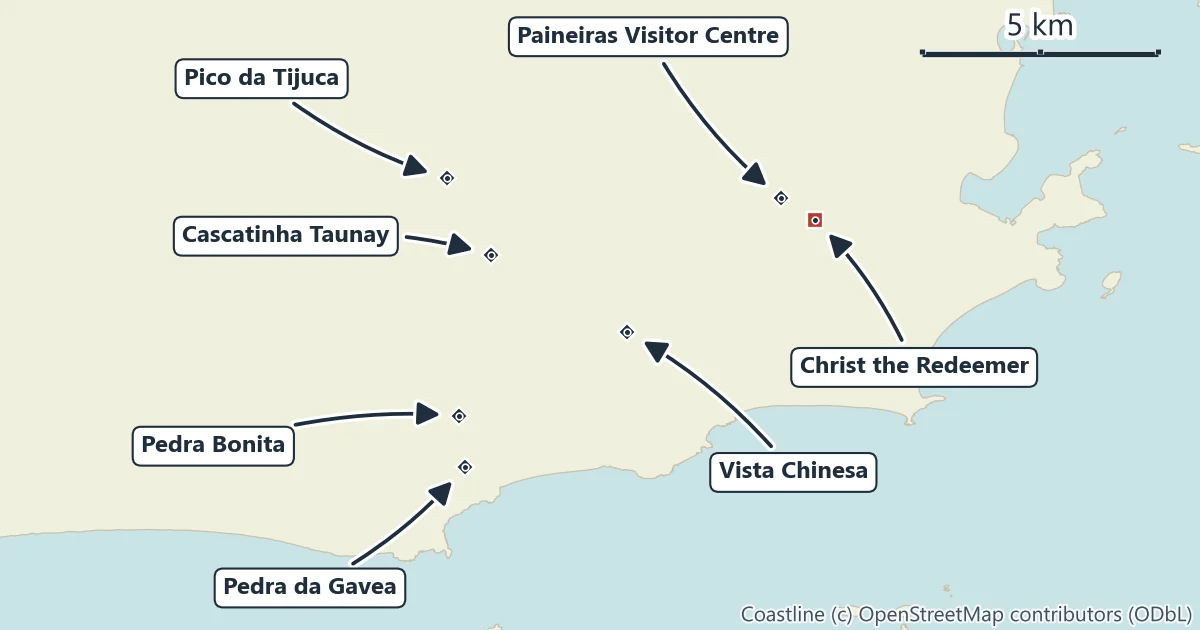
ICMBio’s visiting protocol for the park, PROV 01/2026, signed on 23 February and in force from 2 March 2026, sets the rules that bear on safety:
- Opening hours apply only where the park has gatehouses, and those gatehouses monitor and guide visitors but “do not imply responsibility for visitor safety”.
- Hours can change in extreme weather, and in exceptional cases the park can close to visitors.
- At Bom Retiro, Pedra Bonita, Pedra da Gávea and the Parque Lage trail to Corcovado, you fill in a short form on risks and rules with a phone contact for one member of your group.
- A guide is not mandatory.
- Lakes and weirs are not for bathing; river bathing is banned where signed, for water-supply or environmental reasons rather than your safety.
The 2026 closures
| Date | What | Source |
|---|---|---|
| 7 August 2026 | After a forecast of strong winds, Parque Lage, the Floresta da Tijuca sector, Vista Chinesa, the Mesa do Imperador, Pedra da Gávea and Pedra Bonita were closed, and ICMBio stopped the concessions taking visitors up to Christ the Redeemer from 13:00. The park’s news list carries a closure notice and a reopening notice dated the same day. | Agência Brasil, 7 August 2026; the park’s site |
| 21 August 2026 | ICMBio closed all the park’s trails for strong winds, among them the Parque Lage to Corcovado trail, the Floresta da Tijuca trails including Pico da Tijuca and Cascatinha Taunay’s viewpoint, and the Pedra Bonita and Pedra da Gávea trails. The park’s news list headline that day: “Avoid coming to Tijuca National Park today”. | Diário do Rio, 21 August 2026; the park’s site |
| 22 to 29 October 2026 | Not closures announced by the park, but reviews of Itaway Ecotours' rainforest hike: high winds that had closed much of the park (25 October), closed caves (29 October), and a landslide that changed one group’s route (27 October). | GetYourGuide reviews |
| November 2026 | The park’s site showed no closure in force. | The park’s site, 12 November 2026 |
Both 2026 closures were announced on the day itself. The park’s own site, parquenacionaldatijuca.rio, is where its notices go up.
What the UK Foreign Office says
The UK Foreign Office’s travel advice for Brazil (updated 28 October 2026; checked November 2026) does not mention Tijuca National Park, hiking or Christ the Redeemer. Its lines that bear on a day in the park are these:
- Flash floods and landslides are common in regions where mountains are close to the coast, such as Rio de Janeiro.
- The rainy season runs from November to March in the south and south-east of Brazil, Rio included.
- Forest fires are common from May to September, especially in July and August.
- Robberies are common in many cities, particularly on buses.
It also advises against all but essential travel to parts of Brazil: river areas in the west of Amazonas State, far from Rio.
Slippery rock and the pace
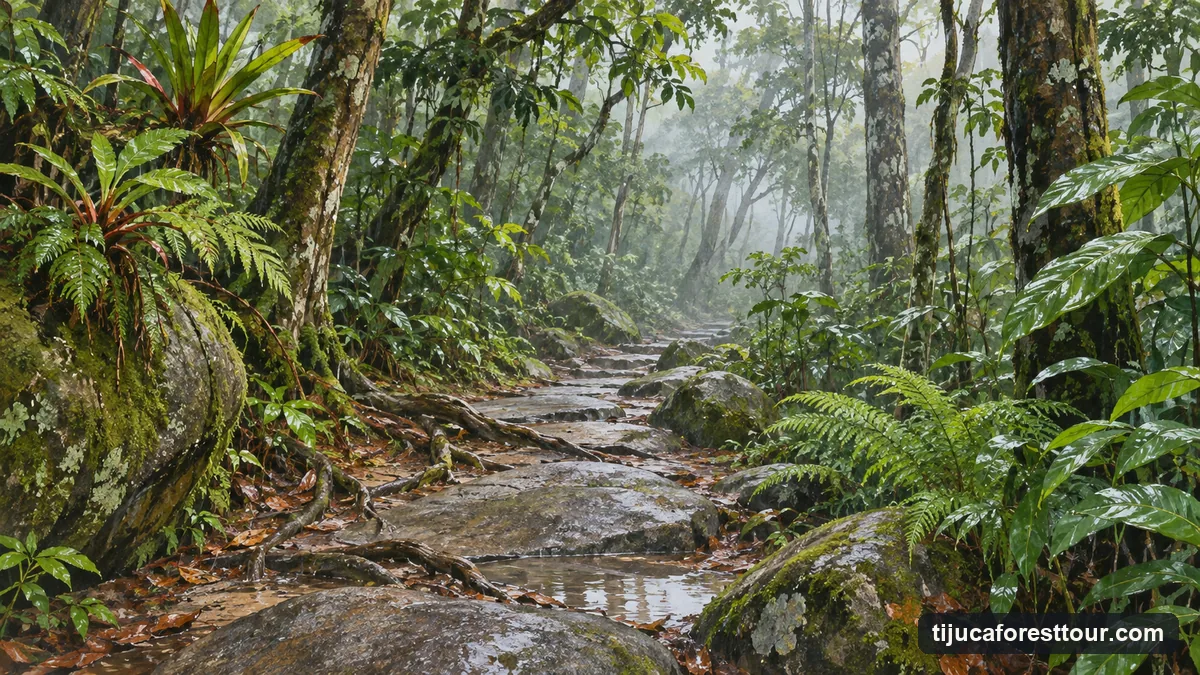
The trails are the other risk, and rain makes them worse. A French reviewer of Itaway Ecotours' hike in October 2026 found it harder than its “moderate” label: wet rock on steep sections, half the group struggling, one person falling. The hike asks for closed-toe shoes and bans sandals and flip-flops. The tour runs in all weather; bring a rain jacket or poncho.
Going with someone
Most of what lowers the risk is how you go: with others, with someone who knows the route, inside the park’s hours, and after checking its site for a closure. The Tijuca Forest hike has the park’s hours by sector and what a guided hike costs.

If You Would Rather Not Go Alone
Itaway Ecotours' small-group rainforest hike, with hotel pickup and a guide who knows the route between the waterfalls and the caves.
Check hike dates